Why the Gulf Arab States Matter So Much – But Decide So Little
The Gulf Arab states have discovered that wealth without hard power, and alliance without political influence, leave them exposed to other countries' wars.
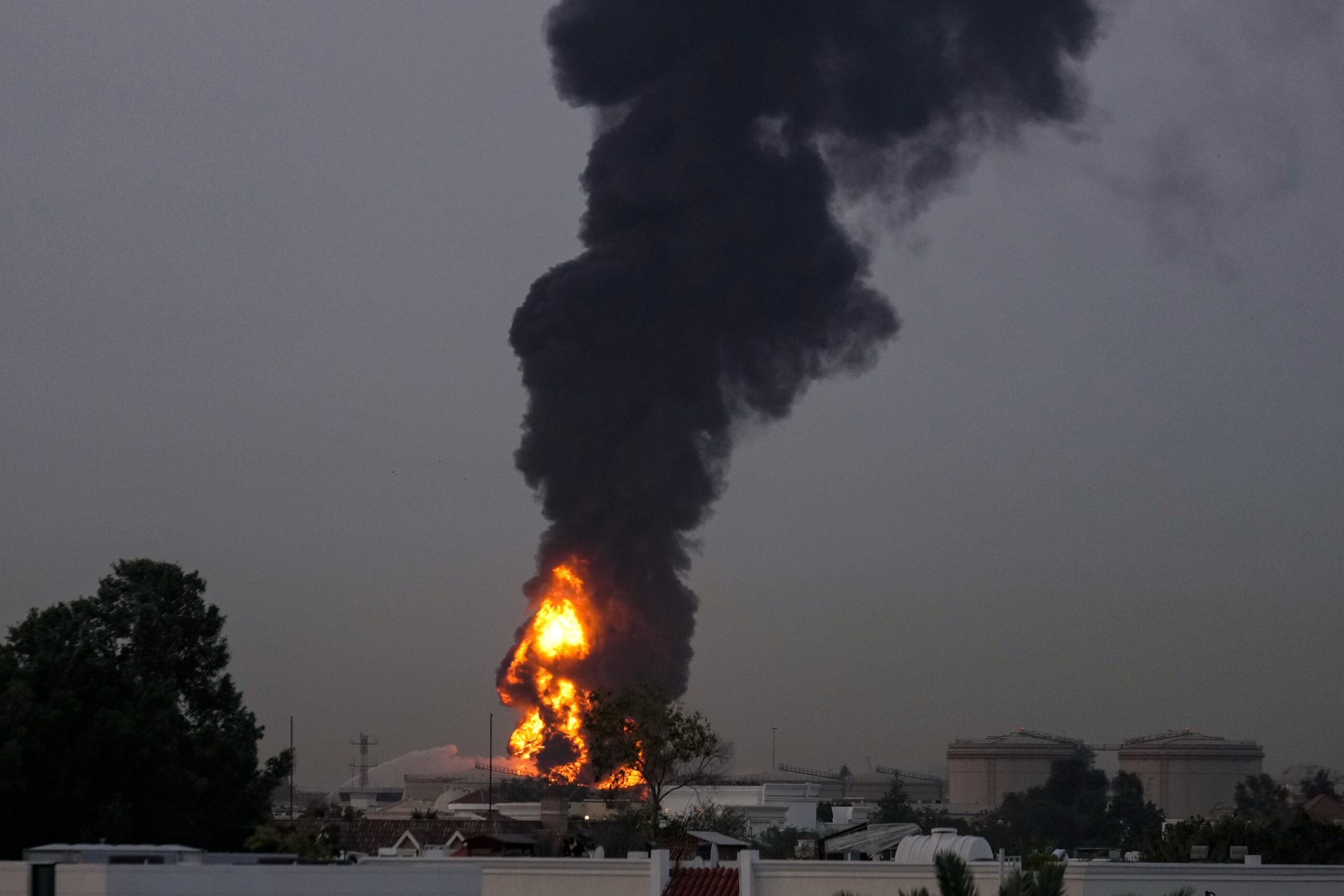
Fire and plumes of smoke rise after a drone struck a fuel tank near Dubai International Airport, in the United Arab Emirates, March 16. (AP Photo)
The Gulf Arab states occupy some of the most valuable real estate in international politics. They straddle the world’s most important energy corridors, connect three continents, command enormous sovereign wealth, and host the United States’ most significant military infrastructure in the region. On paper, few actors appear more central to Middle Eastern security or more consequential to the global economy.
Yet when the region’s most consequential decisions are made – whether to strike Iran, how far escalation should go, what level of economic disruption is acceptable – the Gulf does not set the terms. It is indispensable to the regional order. It is not decisive in shaping it.
The current war has put that imbalance in sharp relief.
Since the United States and Israel struck Iran on February 28, the Gulf monarchies have been drawn into a conflict they neither initiated nor meaningfully shaped. Iranian retaliation has raised the risk to ports, airports, shipping lanes, and energy infrastructure across the region. What this war exposes is not simply Gulf vulnerability; it exposes the lack of Gulf agency at the precise moment when strategic choices are made elsewhere.
Two Approaches, Both With Clear Limits
For years, the Gulf Arab states managed this predicament through two parallel approaches. The first was alignment: anchoring themselves in the U.S. security order through base agreements, arms purchases, and close partnerships with Washington. The second was accommodation: reducing tensions with Iran through diplomacy, in the hope that detente would keep the Gulf from becoming a battlefield. This war has revealed the limits of both.
The Gulf has long figured in U.S. strategic calculations, though it has only risen to the forefront episodically and largely in response to direct threats to the territorial integrity or survival of partner states, efforts to seize control of energy resources, or threats to shipping lanes. These limits have long been evident. Saudi Arabia opposed the 2003 invasion of Iraq, yet the United States invaded anyway. Saudi and Emirati leaders viewed the handling of the Arab uprisings by the administration of President Barack Obama and its pursuit of the Iran nuclear deal with deep unease, but Washington proceeded regardless. In each case, the Gulf bore the consequences of U.S. policy without having much power to shape it.
The pattern has reappeared in the current war. When Israeli escalation preferences collide with Gulf vulnerability, Israel commands greater weight in Washington’s calculus. The administration of President Donald J. Trump understood that military confrontation with Iran would impose serious economic and infrastructural costs on its Gulf partners. It moved ahead regardless – even as Omani mediation between Washington and Tehran was gaining traction and Oman’s foreign minister was publicly signaling diplomatic progress. The lesson: Alignment with the United States may deter conventional invasion, but it does not guarantee that Gulf interests will register in Washington as a genuine strategic priority when harder choices have to be made.
The second limitation is that detente may reduce tensions in peacetime, but it cannot shield the Gulf from exposure once war begins. The 2023 Saudi-Iranian rapprochement, facilitated by Iraq and Oman, and ultimately secured by China, was a rational attempt to break a dangerous strategic cycle. The Gulf Arab states host the core of the U.S. military footprint in the region – an arrangement that offers protection but also makes them the obvious target for any actor seeking to impose costs on Washington. Reopening diplomatic channels with Tehran was a logical effort to reduce that exposure.
In calmer times, the approach seemed to work. Tensions eased. Direct confrontation appeared to recede. But peacetime diplomacy and wartime incentives are not the same. Once the Iranian regime perceived existential pressure, diplomatic goodwill lost its restraining force. Tehran looked for leverage where it exists – and much of it lies in the Gulf: energy facilities, ports, maritime chokepoints, the dense concentration of U.S. military assets across Arab territory. Even Oman and Qatar, which have historically maintained more stable ties with Iran, could not insulate themselves from a wider regional war. Detente can lower temperatures. It cannot erase geography or the strategic logic of escalation. Nor can it account for Israel, which was not party to the detente and could view Gulf-Iran rapprochement as normalizing a dangerous adversary and act accordingly.
Why the Gulf Still Decides So Little
The deeper question is structural: Why do states that matter so much economically decide so little politically?
The first answer lies at home. Gulf Arab states never built the autonomous military-industrial base that underpins real strategic independence. Unlike Israel, Turkey, or Iran, they did not develop a domestic ecosystem capable of sustaining military production, absorbing the costs of prolonged conflict, or projecting force with relative autonomy. Saudi Arabia has spent extraordinary sums on advanced weapons, yet it struggled for years against Yemen’s Houthi rebels on its southern border. That exposed a structural weakness: The kingdom’s armed forces were not designed primarily for autonomous regional warfare; they were designed for regime survival.
This can be understood in terms of regime security priorities. In many monarchies, internal security takes precedence over battlefield effectiveness. Military institutions are fragmented and politically constrained so that no single armed actor can threaten the ruling order. The result is forces that are expensive, heavily armed on paper, and limited in war – states rich enough to purchase sophisticated weapons but not institutionally configured to convert those weapons into strategic autonomy.
The 1990-91 Gulf War reinforced the pattern. It showed that the United States could protect Gulf states from conventional invasion, but it also deepened the habit of outsourcing the hardest questions of external security. Over time, that bargain produced a regional order in which the Gulf became too rich to ignore, too exposed to dismiss, and too militarily dependent to shape outcomes on its own terms.
The second answer lies in Washington. Decades of alliance with the United States never produced the kind of entrenched political influence that Israel has built in U.S. domestic politics. The Gulf states bought arms, hosted bases, invested heavily in the U.S. economy, and cultivated close ties with successive administrations. But influence in Washington is not transactional. It is institutional, ideological, congressional, and social – reproduced through think tanks, advocacy networks, donor circles, and durable political narratives. Israel built that ecosystem over generations. The Gulf has not. Personal ties produce goodwill and occasional tactical concessions. They rarely shape the broader strategic consensus when the stakes are high. In this war, the Gulf is not a principal author of strategy. It is the terrain on which the strategies of others are carried out.
Gulf Security
None of this points toward a simple geopolitical pivot. The Gulf states are not going to abandon the U.S. security framework, because no other outside power can replace it. The United States remains the only actor capable of providing integrated missile defense, advanced intelligence, maritime coordination, and credible conventional deterrence at the scale the Gulf requires. Russia lacks both the capacity and the sustained commitment. China lacks the military reach – and, for now, the appetite – for hard-security entanglement in the region. Saudi Arabia may deepen cooperation with countries such as Turkey or Pakistan, but neither can substitute for the United States in the core architecture of Gulf defense.
The more relevant question is whether the Gulf can convert economic centrality into real strategic leverage.
For decades, Gulf leaders treated capital primarily as a tool of prestige, access, and goodwill. But wealth can be deployed more deliberately. Gulf states control vast sovereign wealth funds, remain central to global energy pricing, and are increasingly intertwined with the United States in sectors that will define the next era of geopolitical competition: artificial intelligence infrastructure, data centers, critical-mineral processing, advanced energy, and strategically sensitive supply chains. Saudi and Emirati partnerships with U.S. firms have moved well beyond oil and arms. They are now embedded in the infrastructure of the future economy.
That creates an opening for a more serious strategy. Rather than relying on personal diplomacy with presidents, Gulf governments should pursue more formalized bargains: earlier consultation before military operations launched from or through Gulf territory, clearer rules governing base usage, deeper missile-defense integration, and explicit recognition that Gulf economic exposure cannot be treated as acceptable collateral damage in conflicts decided elsewhere. Gulf capital should not merely guarantee access. It should translate into procedural influence.
Yet even that addresses only part of the problem. In the long run, Gulf security depends not on better external bargains alone but on domestic strengthening. This does not mean building mass armies. It means building states with greater productive capacity, economic resilience, and institutional depth. Long-term stability cannot rest indefinitely on hydrocarbon rents backed by foreign protection.
This is where deeper economic cooperation with China becomes strategically relevant – not as an alternative to U.S. security, but as part of a broader project of state building. China matters not only as the largest buyer of Gulf oil but as an increasingly important partner in manufacturing, industrial value chains, and technological ecosystems – sectors where China has accumulated real expertise, and the Gulf has historically lagged. Economic transformation, in this light, is not separate from security.
That may be the hardest lesson of this war. For decades, the Gulf monarchies tried to purchase safety from stronger powers while minimizing the domestic political risks of building more autonomous forms of capacity. The strategy produced wealth, relative stability, and structural dependence in roughly equal measure. Now the bill is coming due.
The problem is not that the Gulf lacks powerful friends. It is that it has not learned how to matter enough to them when it counts. Until that changes, the Gulf monarchies will remain essential to the regional order yet peripheral to the decisions that repeatedly set it ablaze.
The views represented herein are the author's or speaker's own and do not necessarily reflect the views of AGSI, its staff, or its board of directors.
Caught between Iranian strikes and U.S.-Israeli pressure to join the fight, Gulf Arab states strive to maintain their autonomy over decision making, playing defense and preserving the space to maneuver when the war ends.
Though they were unsuccessful in preventing the current conflict, and, as expected, have been dragged into the U.S.-Israeli confrontation with Iran, Gulf Arab countries remain crucial to hopes for limiting the war and bringing it to a quick resolution.
Gulf Arab countries urged the United States not to strike Iran, but now that is happening, they are in danger of being sucked into a conflict they cannot control but that will likely reshape their present and future realities.