Houthi Myth of Israeli-Saudi Collusion May Become a Self-Fulfilling Prophecy
The Houthis appear to be following a North Korean playbook, using recurring cycles of provocation to extract concessions, forcing Saudi Arabia to carefully calculate its security ties.
Supporters of Yemen's Houthi movement watch a speech by the movement's leader, Abdul Malik al-Houthi, displayed on a big screen in Sanaa, Yemen, July 6. (REUTERS/Khaled Abdullah)
For years the Houthis have sold their audience a simple story. Israel and Saudi Arabia are working together to strangle their movement, and every setback in Yemen is proof. For the Saudis, the story has been easy to dismiss as propaganda. Houthi official media and its wider social ecosystem routinely brand both intermittent U.S. and Israeli strikes and the earlier Saudi-led military campaign as Saudi-Emirati-U.S.-Israeli aggression. The risk today is that the interaction of events in Gaza, the Red Sea, Israel, and Saudi Arabia could turn this narrative into operational truth. As the Gaza front cools, the Houthis are refocusing aggressively on Saudi Arabia, at least rhetorically. In doing so, they are creating incentives and pressures that could make informal alignment between Israel and the kingdom more likely, not less.
Houthi leader Abdul Malik al-Houthi set the tone in televised remarks in mid-September. In perhaps his harshest attack yet on Saudi Arabia he accused Riyadh of serving Israeli interests and warned of consequences if the kingdom deepened its role in Red Sea security. His speech followed the September 16 Yemen Maritime Security Partnership conference, co-hosted by Saudi Arabia and the United Kingdom, with representatives from more than 35 countries. The initiative was presented as a technical capacity building program for Yemen’s coast guard, framed around lawful efforts to counter smuggling, piracy, and human trafficking. Saudi officials pointed to decades of support, citing $55.6 million in historical coast guard assistance and a new $4 million pledge. For Abdul Malik al-Houthi, these were not neutral numbers. He argued that any banner raised to protect navigation now means protecting Israeli shipping and told Riyadh to avoid entanglement. His rhetoric ended with a vow that Saudi efforts would fail to secure Israeli vessels.
Kinetic and cyber signals reinforced the message. Pro-Houthi groups claimed to have penetrated Saudi logistics networks and tracked more than 60 oil tankers, hinting at destructive attacks if Riyadh persisted in backing anti-Houthi forces. Over the same period, maritime authorities logged two incidents in the northern Red Sea. One vessel 40 nautical miles southwest of Yanbu reported a splash from an unknown projectile and a loud bang. Another incident 178 nautical miles northwest of Hodeidah combined a water impact with severe electronic interference. There were no mass casualties, was no escalation to cities, but the incidents were significant enough to place the western energy and trade corridor within psychological warfare reach of the Houthis.
The political track moved at the same time. Riyadh hosted mediation meetings that brought members of the Presidential Leadership Council together with the Saudi and Emirati ambassadors. The result was a carefully staged show of unity. Smiling leaders after two days of talks and a subsequent council meeting September 18 reaffirmed the partnership, collective leadership, and adherence to the legal framework that governs the council. The council agreed to review decisions that conflict with its founding resolution within 90 days and examine appointments by Aidarous al-Zubaidi, vice president of the Presidential Leadership Council. A legal team will work with the Military and Security Committee to address force management issues. This is precisely the kind of statecraft that the Houthis read as consolidation against them. Yemen analysts have consistently encouraged Abu Dhabi and Riyadh to tighten coordination on the Yemen file. The September mediation meetings demonstrated a cohesive Saudi-Emirati strategy, which is necessary for any durable stability. But from the Houthis’ vantage point, it is also another sign of encirclement that will agitate their leadership and harden their information campaign.
The security picture that most unsettles the Houthis is the convergence of Red Sea control and the resurgence of anti-Houthi formations backed by Saudi Arabia and the United Arab Emirates. The National Resistance Forces now operate as an active and effective presence along Yemen’s western coast and near the Bab el-Mandeb strait, with a well-documented record of stopping Iranian arms shipments. Tariq Saleh, who leads the National Resistance Forces, also serves as vice president of the Presidential Leadership Council and has been a prominent adversary of the Houthis since the 2017 rupture with the group, which ended with the Houthis killing his uncle, late President Ali Abdullah Saleh. Saudi-funded units, including the National Shield Forces, have deployed across desert and border corridors to secure overland routes and disrupt Houthi smuggling and infiltration. UAE-backed formations, including the Counterterrorism Service and the Southern Giants Brigades, have intercepted shipments of Chinese dual-use equipment destined for Houthi networks. From the Houthis’ perspective, Riyadh’s engagement with maritime forces and the wider anti-Houthi camp form the backbone of a strategy that squeezes supply chains at sea while rebuilding a rival security architecture on land.
The Houthis’ public interpretation of the government forces’ military maneuvers exaggerated the coherence of a deeply fragmented coalition. Nevertheless, they promoted this narrative, fully aware of its distortions, because it served their public messaging. However, the main driver of their harassment remains economic pressure. Israeli strikes have targeted transportation and energy hubs tied to the Houthis and have disrupted external lifelines, including flights. U.S. terrorism designations and sanctions have narrowed financial channels. Trade flows, fuel access, and currency movements are constrained. Under these conditions the cheapest form of leverage for the Houthis is to raise the cost of Saudi calm without crossing the threshold that would trigger a decisive international response. Drones striking refineries would court war. Cyber intrusions, electromagnetic interference at sea, and unclaimed projectiles that splash near hulls are sufficient to lift insurance rates and capture the attention of Riyadh. They are also deniable enough to manage escalation. Electronic warfare and maritime harassment promise pressure without courting overly harsh or collective responses. It is coercive diplomacy by attrition.
The Houthis’ bargaining demand is not subtle. They want Saudi Arabia to sign and implement the United Nations roadmap with clauses that commit Riyadh to fund 6 to 12 months of public sector salaries in Houthi-controlled areas, including in the security and defense sectors, and to seed a reconstruction fund.
Saudi Arabia’s restrained response stems from deeper structural factors. The kingdom tried sustained military pressure for eight years without approaching an achievable military and political end state. The anti-Houthi coalition remains fragmented, with divergent chains of command and competing sources of external support. Western partners who could change the balance quickly do not want a new Yemen war. Riyadh is, therefore, seeking to avoid a large military campaign and is instead investing in layered defenses, maritime domain awareness, and partner capacity that hardens critical nodes while at the same time pushing the Presidential Leadership Council to function. This strategy was visible in September. Saudi money flowed to the United Nations-recognized government, and the Presidential Leadership Council staged its reset. Senior Saudi and Yemeni commanders inspected forces in Medi, Hairan, Haradh, Abs, and a naval unit operating in nearby islands. None of this ends the war. All of it attempts to counter Houthi pressure while making the Red Sea a more contested space.
Hezbollah’s leader, Naim Qassem, a key Houthi ally, seeks to immunize Lebanon from this regional spiral by urging Saudi Arabia to open a new chapter with the Lebanese “resistance” and stressing that its weapons target Israel rather than the kingdom. The Houthis use the same vocabulary to argue the opposite. Their claim is that Saudi Arabia is already inside Israel’s war.
In September, Houthi security and intelligence sources alleged that Israel, working through Saudi channels, funneled money to recruit “mercenaries” to hijack what they described as national Yemeni events and stir unrest. In fact, the Houthis went further, publishing through their official news agency a study claiming Israeli strategists view Riyadh as the grand prize of normalization and that Saudi entry into the Abraham Accords would reconfigure the region’s security architecture. It hypothesized preconditions including a Gaza cease-fire, U.S. security and civil nuclear guarantees for Saudi Arabia, and calibrated detente with Iran, framing these as evidence of emerging Saudi, U.S., and Israeli coordination with far-reaching implications.
To feed their collusion narrative, Houthi channels amplified a claim that Saudi Arabia’s national shipping company, Bahri, was moving U.S. weapons to Israel via the vessel Bahri Yanbu. Bahri issued a categorical denial, calling the reports baseless, affirming it has never carried cargo to Israel, and stressing full compliance with Saudi policy on Palestine and all maritime laws. The allegation appears to originate from Italian media reports claiming that Italian dockworkers blocked a Saudi ship carrying weapons destined for Israel, a shipment that Bahri has categorically denied.
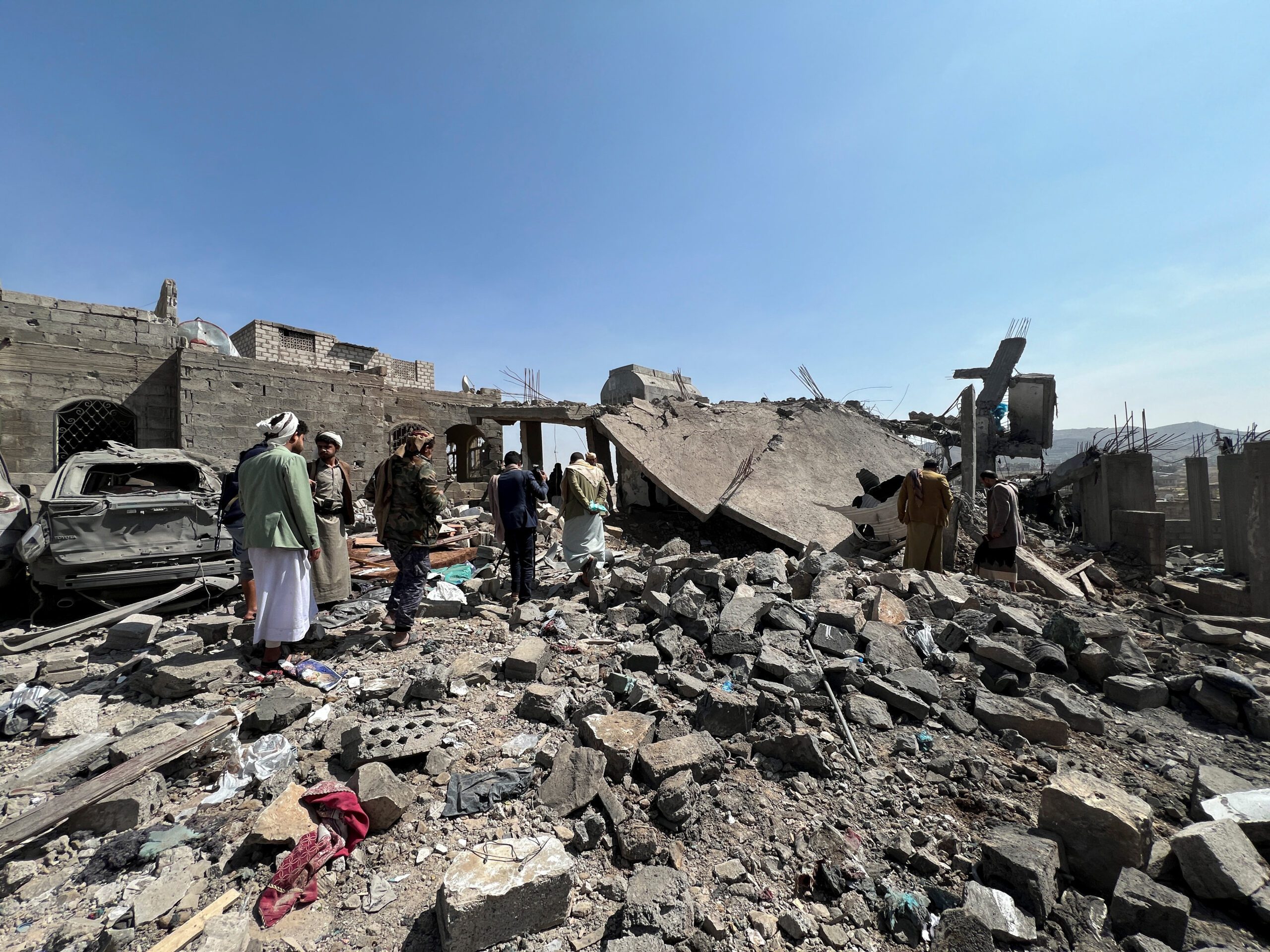
This is how the myth seems to slide toward something real, even if only apparently so. Israeli strikes in Sanaa created visible damage to Houthi leadership, security, and propaganda nodes. Saudi budget support to Aden, Saudi and Emirati mediation with the Presidential Leadership Council, and the coast guard partnership project are all public. If Houthi harassment pushes Riyadh to adopt faster intelligence fusion with any actor who can suppress launch sites and defeat drones, then practical cooperation could follow. It does not require a treaty or a grand alliance. It would only require shared intelligence, surveillance, and reconnaissance, deconfliction cells, and a willingness to move data and tactics that shrink the time between detection and effect. Israel has those tools on the shelf. Saudi Arabia will have to assess whether, in the scope of its broader strategic interests, it would make sense to use any tool that protects the southern border with Yemen, sea lanes, and oil infrastructure and whether the risks could be controlled at a manageable political cost.
The Houthis appear to be following a North Korean playbook, using recurring cycles of provocation to extract political and economic concessions. Just as Pyongyang conducts missile tests and issues military threats to gain leverage over South Korea, Japan, and the United States, the Houthis are turning their territories south of Saudi Arabia and the Red Sea into their stage. When they seek funds or influence, they escalate harassment and information operations targeting Saudi-linked energy and global logistics networks. In return, Riyadh is likely to respond by reinforcing defenses, supporting coalition partners, and expanding discreet security ties. This ongoing cycle of tit-for-tat actions, without a holistic or lasting resolution, is likely to persist. Each round produces temporary pauses and partial concessions, while the Houthis claim symbolic victories that sustain the pattern and strengthen their narrative.
The views represented herein are the author's or speaker's own and do not necessarily reflect the views of AGSI, its staff, or its board of directors.
Negotiations in Riyadh will determine whether the Presidential Leadership Council emerges as a functional governing body or dissolves into a symbol of Yemen’s enduring divisions.
A Gulf-Yemen energy corridor could reshape the Arabian Peninsula. But it cannot happen without a durable political settlement involving the Houthis and other Yemeni factions.
Negotiations in Riyadh will determine whether the Presidential Leadership Council emerges as a functional governing body or dissolves into a symbol of Yemen’s enduring divisions.