Past Event
The GCC Economies: Weathering the Oil Slump?
Date
Jun 10, 2015
About the event
The recent slump in oil prices presents challenges as well as opportunities for the countries of the Gulf Cooperation Council. While lower oil prices affect overall growth and reduce fiscal surpluses, decision-makers may be encouraged to accelerate and deepen structural reform efforts to improve energy efficiency and diversify their economies. What are the implications of a long-term oil slump and how will the GCC states choose to mitigate it? How will the recent more assertive foreign policies of some GCC states be affected by a reduction in oil prices and how will local populations react to possible broadening of the tax base or a reduction in subsidies and benefits?
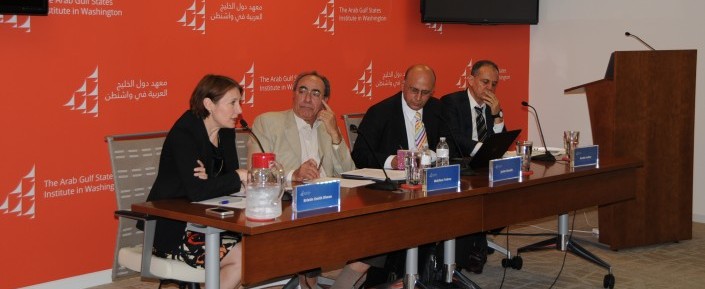
Garbis Iradian, a chief economist at the Institute of International Finance, projects that despite the slump in oil prices, government spending in the GCC states will continue to increase, only at a lower rate, thanks to the incredible amount of financial assets accumulated in the past decade. But if low oil prices persist for a prolonged period of time, GCC states will face pressures to reduce public spending and raise non-oil revenue, therefore providing them with the opportunity to make progress in structural reforms. Jasim Husain, a columnist on the political and economic affairs of the GCC for Gulf News, focused on how the GCC channels money toward foreign policy, sports, and aviation endeavors in order to create ample business opportunities for the Gulf states. Concentrating more on the challenges of low oil prices, Mahfouz Tadros, an associate at Graffeo & Associates, asserted that the slump provides the GCC with the opportunity to admit to and tend to internal issues. Tadros highlighted the importance of developing a knowledge-based economy, putting governmental efforts toward public awareness campaigns and science, technology, engineering, and mathematics (STEM) education. All panelists agreed that increased diversification of the GCC economies is necessary in order to weather the oil slump, and that a shift in governmental mentalities needs to take place in order for this to happen.
Moderator: Kristin Smith Diwan, Senior Resident Scholar, Arab Gulf States Institute in Washington
Jasim Husain, columnist on the political and economic affairs of the GCC for Gulf News
Garbis Iradian, chief economist at the Institute of International Finance
Mahfouz Tadros, associate at Graffeo & Associates
The views represented herein are the author's or speaker's own and do not necessarily reflect the views of AGSI, its staff, or its board of directors.
